
Heart Health: The Complete Guide to a Stronger, Healthier Heart
Heart health isn’t just a line item on your annual physical — it’s the foundation almost every other health metric sits on top of. According to the American Heart Association, up to 80% of heart disease and stroke cases may be preventable through everyday lifestyle choices. That’s a staggering number, and it means your cardiovascular health is largely in your own hands.
The good news? Improving your heart health doesn’t require a total life overhaul. It comes down to a handful of daily decisions — what you eat, how you move, how you sleep, and how well you handle stress and blood pressure management. Below, we break heart health down into a clear, science-backed framework, complete with a diet cheat-sheet, age-specific workouts, and the honest truth about stress and sleep — everything you need to start protecting your heart health today.
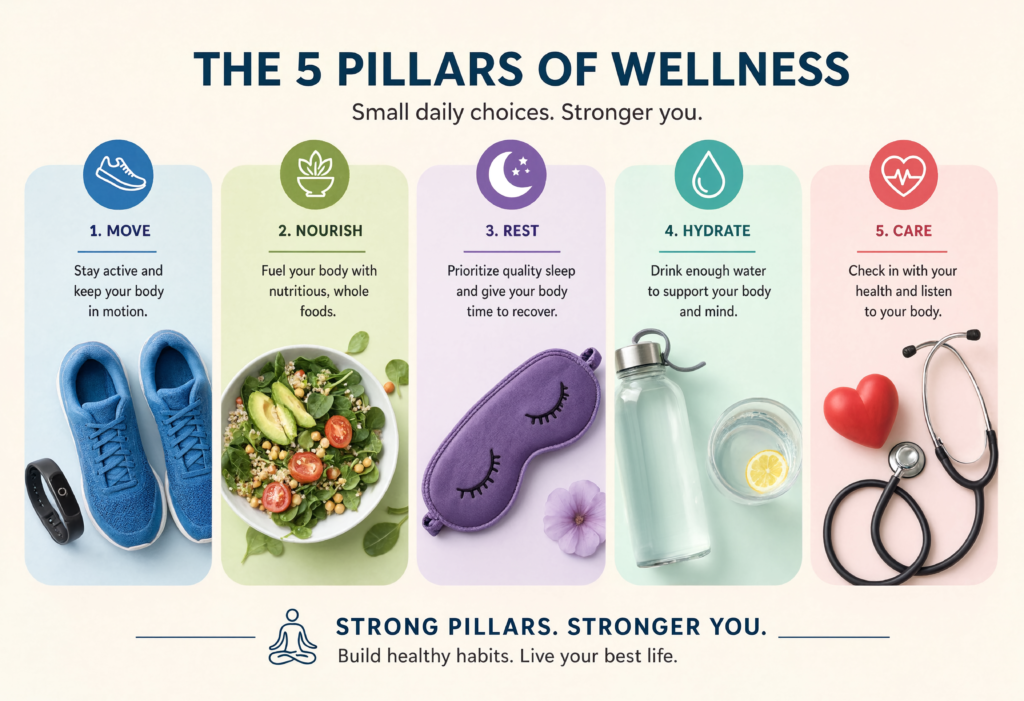
What Are the 5 Pillars of a Healthy Heart?
If you only remember one section of this article, make it this one. Cardiologists generally agree that long-term heart health rests on five pillars — master these and you’ve covered most of what matters for lifelong heart health:
- Cardiovascular Exercise – Regular aerobic movement that gets your heart rate up.
- Nutrient-Dense Diet – Whole, minimally processed foods that support healthy cholesterol and blood sugar.
- Restorative Sleep – 7–9 hours of quality sleep per night.
- Stress Mitigation – Actively managing cortisol and nervous system overload.
- Routine Screenings – Knowing your numbers: blood pressure, cholesterol, blood sugar, and BMI.
This framework distills the American Heart Association’s own “Life’s Essential 8”
checklist — which also includes quitting tobacco and managing weight — into the five levers that make the biggest day-to-day difference for most people’s heart health. Nail these five, and the rest tends to follow.
The Heart-Healthy Diet (Going Beyond the “Eat Better” Advice)
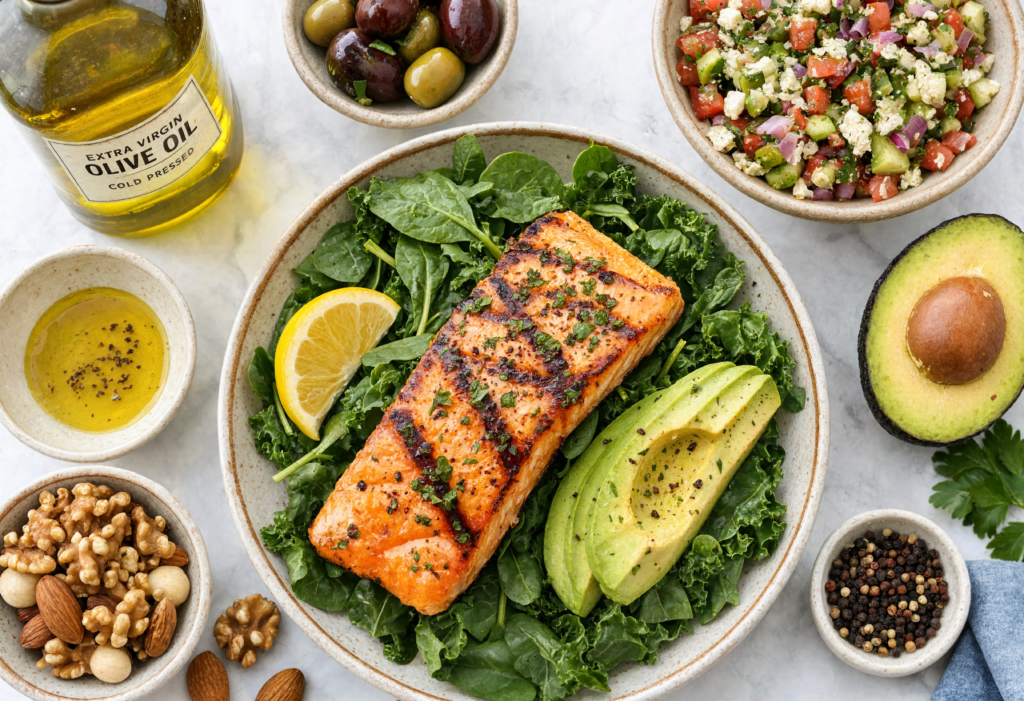
Most articles stop at “eat more vegetables.” That’s not wrong, but it’s not useful either. Here’s what the science actually says about which foods support heart health and cardiovascular health — and which ones quietly undermine it.
| Foods to Eat | Foods to Avoid | Why (The Science) |
|---|---|---|
| Fatty fish (salmon, mackerel, sardines) | Processed & deli meats | Omega-3 fatty acids lower triglycerides and reduce inflammation; processed meats are linked to higher cardiovascular disease risk via sodium and nitrates |
| Leafy greens & cruciferous vegetables | Fried foods & trans fats | Dietary nitrates support healthy blood vessel dilation; trans fats raise LDL (“bad”) cholesterol while lowering HDL |
| Extra virgin olive oil, nuts, seeds | Sugary drinks & ultraprocessed snacks | Monounsaturated and polyunsaturated fats improve cholesterol ratios; added sugar is tied to inflammation and rising blood pressure |
| Legumes, beans, lentils | Excess sodium (canned soups, fast food) | Plant protein lowers LDL cholesterol without the saturated fat load of red meat; sodium directly raises blood pressure by increasing fluid retention |
| Whole grains (oats, quinoa, barley) | Refined carbs & white bread | Soluble fiber binds to cholesterol in the gut and helps remove it; refined carbs spike blood sugar and promote arterial inflammation |
This approach mirrors the AHA’s 2026 updated dietary guidance, which centers on whole foods, plant-based proteins, and unsaturated fats while explicitly limiting sugar, sodium, and ultraprocessed products — a shift toward sustainable eating patterns rather than short-term rules. Think of the table above as your grocery list filter: if a food shows up more in the left column than the right over the course of a week, your diet is doing real work for heart health and heart disease prevention.
The Best Exercises for Heart Health (By Age & Fitness Level)
Exercise is one of the fastest levers you can pull for heart health. The AHA recommends 150 minutes of moderate activity or 75 minutes of vigorous activity per week for adults. That’s the target — but how you hit it should look different depending on your life stage.
The 15-Minute Routine for Busy Professionals
No gym, no equipment, done before your first meeting:
- 0–3 min: Brisk walk in place or march to warm up
- 3–8 min: 5 rounds of 30 seconds bodyweight squats + 30 seconds rest
- 8–12 min: 4 rounds of 30 seconds push-ups (or incline push-ups) + 30 seconds rest
- 12–15 min: Cool-down stretch focused on hips and shoulders

Done 4–5 times a week, this hits roughly the weekly moderate-to-vigorous activity target without eating into your lunch break.
The Low-Impact Routine for Seniors
Gentle on joints, still effective for cardiovascular health and blood pressure management:
- Warm-up (5 min): Seated marching or slow walking
- Main set (15–20 min): Alternate 5 minutes of brisk walking with 2 minutes of easy walking, repeated 2–3 times
- Strength add-on (10 min): Chair squats, wall push-ups, resistance-band rows — 2 sets of 10–12 reps each
- Cool-down (5 min): Gentle stretching, focusing on calves and lower back
Water aerobics and stationary cycling are excellent alternatives if joint pain is a limiting factor. Always check with a physician before starting a new exercise program, particularly with an existing cardiac condition.
The Hidden Threat: How Stress and Sleep Impact Your Heart
Diet and exercise get all the attention, but stress and sleep may be the most underrated pieces of the heart health puzzle — and of heart disease prevention more broadly.
A systematic review and meta-analysis on stress hormones and cardiovascular risk indexed on PubMed found that elevated cortisol and other stress hormones were significantly associated with a greater risk of cardiovascular disease compared with lower levels. Mechanistically, chronic HPA-axis (hypothalamic-pituitary-adrenal) activation appears to drive this risk by contributing to hypertension, metabolic syndrome, and vascular inflammation over time — even in people whose cholesterol numbers look otherwise normal.
Sleep tells a similar story. Research highlighted by Harvard Health Publishing and the AHA shows that adequate sleep — generally 7 to 9 hours nightly for adults — promotes healing, supports healthy blood pressure regulation, and reduces chronic disease risk.
Practical ways to protect both — and your heart health along with them:
- Set a consistent sleep-wake time, even on weekends — circadian regularity matters as much as total hours.
- Try box breathing (4 seconds in, 4 hold, 4 out, 4 hold) during stressful moments to activate the parasympathetic nervous system.
- Limit caffeine after 2 PM if it’s disrupting sleep onset.
- Build in a 10-minute “worry window” earlier in the day so bedtime isn’t when your brain processes stress.
- Move daily, even briefly — exercise is one of the most effective cortisol regulators available.

For a deeper dive into the biology, the American Heart Association
and the peer-reviewed research indexed on PubMed are excellent starting points if you want to go further than this overview.
Frequently Asked Questions
Here are quick, evidence-based answers to the heart health questions people search for most.
What is the best drink for heart health?
Water is the simplest and most reliably heart-healthy choice — it supports healthy blood volume and blood pressure without added sugar or sodium. Unsweetened coffee and tea (green tea in particular) are linked to modest cardiovascular benefits in observational research, largely due to their polyphenol content. Alcohol, by contrast, should be limited; even moderate intake can raise blood pressure and contribute to arrhythmias in some people.
Can you reverse heart disease naturally?
Lifestyle changes can meaningfully slow, and in some documented cases partially reverse, early-stage atherosclerosis — particularly through sustained improvements in diet, exercise, stress management, and cholesterol control. This is not a guarantee, and “reversal” looks different for every patient depending on how advanced the disease is. Anyone with diagnosed heart disease should pursue lifestyle changes alongside — not instead of — a cardiologist’s guidance.
What are the first signs of a weak heart?
Common early warning signs include unusual fatigue, shortness of breath (especially with mild exertion or when lying flat), swelling in the legs, ankles, or abdomen, a persistent cough or wheezing, and a rapid or irregular heartbeat. These symptoms can also stem from unrelated conditions, so they’re not a diagnosis on their own — but any combination of them warrants a prompt conversation with a healthcare provider rather than a wait-and-see approach.
The Bottom Line
Great heart health isn’t built in a single workout or one perfect meal — it’s the compound interest of small, repeated choices across diet, movement, sleep, and stress management. Start with one pillar, build the habit, then layer in the next. Your future cardiovascular health — and your heart health decades from now — will reflect exactly the effort you put in today.
This article is for informational purposes only and is not a substitute for professional medical advice. Talk to your doctor before starting any new diet or exercise program, especially if you have an existing heart condition.